Last week I wrote about the shift from Vibe-Writing to Vibe-Managing (Read here)
While Agentic AI and agentic workflows have become a buzzword & everyone wants to be part of this bandwagon but for most people it’s still rocket science.
They sign up for n8n or Copilot Studio or whatever is the platform of the week basis trending YouTube videos or articles, stare at a blank canvas, and have no idea what to build.
So they build nothing or end up building something so trivial that does not really have an impact for them. In worst case scenarios they use unsecure tools or automate a process in a manner that it ends up compromising their data.
In most cases the project or workflow lies unused and they continue to toil with manual work as usual.
The mistake – Starting with the tool and diving headlong into automation without building the foundation.
The tool should be the last decision. Not the first.
Even before choosing the tool or writing a single line of prompt we need to choose the right scope, ensure readiness and process following a step by step sequence.
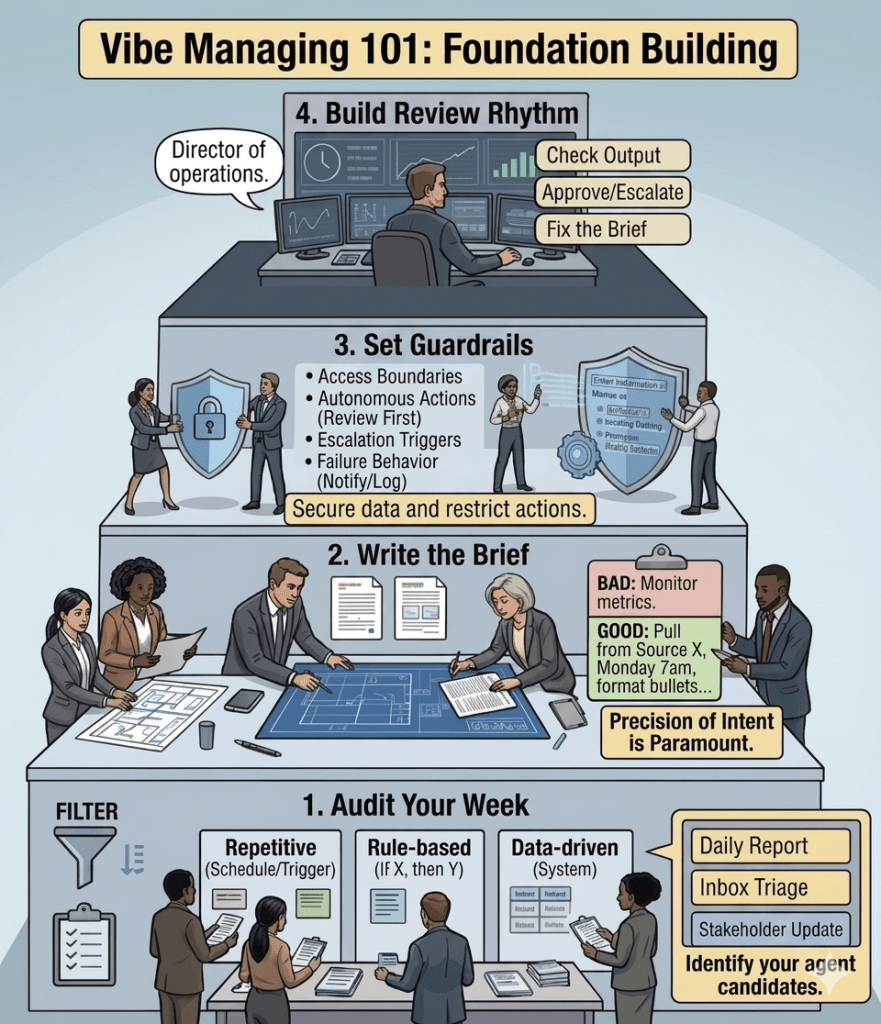
Step 1: Audit Your Week Before You Touch Anything
Before you open a single platform, spend 20 minutes with a blank document and answer this question: What did I do last week that I will do again this week, in roughly the same way, using roughly the same inputs?
Those are your agent candidates.
The filter is simple. A task is agent-ready if it is:
- Repetitive — it happens on a schedule or a trigger, not randomly
- Rule-based — the logic is definable. If X, then Y. Not “it depends on my judgement.”
- Data-driven — the inputs come from a system, not a conversation
Your weekly efficiency report. Your inbox triage. Your data pull before the Monday standup. Your competitor monitoring. Your stakeholder update draft.
These are not strategic tasks. They are logistics. And you are currently doing logistics when you should be doing strategy.
Write the list. Don’t edit it yet. Just get it down.
Step 2: Write the Brief. Properly.
This is where most Vibe-Managing attempts fail before they start. People give agents the same vague instruction they’d give a junior analyst on day one and then wonder why the output is useless.
Here’s the difference:
Bad brief: “Monitor our support metrics and flag anything unusual.”
Good brief: “Every Monday at 7am, pull last week’s data from . Flag any metric that is more than 10% below the 30-day rolling average. Draft a three-bullet summary in this format: metric name, deviation percentage, likely cause based on the last three incident logs. Route to [name] for review by 8am.”
Notice what changed. The goal is specific. The timing is defined. The threshold is a number, not a feeling. The format is prescribed. The recipient is named.
Precision of intent is the primary skill of a Vibe-Manager. Everything downstream — the quality of the output, the reliability of the workflow, the time you save — is a direct function of how clearly you wrote the brief.
If you can’t write the brief in plain language, you don’t understand the task well enough to automate it yet. Go back to doing it manually once more and document exactly what you do.
Step 3: Set the Guardrails Before You Launch
Most people tend to skip this step even though this is the step that determines whether your agent is an asset or a liability.
Before any agent touches a live workflow, answer four questions:
- Access: What data sources and systems can this agent see? Define the boundary. Not “everything it needs” — that is not a boundary.
- Autonomous actions: What can it do without asking you? Send a draft to a folder, yes. Send an email to a stakeholder, not until you’ve reviewed output quality over at least two weeks.
- Escalation triggers: What conditions should cause it to stop and flag you instead of proceeding? Define these explicitly.
- Failure behaviour: If the data source is unavailable or the output looks wrong, what happens? Does it notify you? Does it skip and log? Does it guess? You decide. Not the agent.
Guardrails are not bureaucracy. They are the difference between a digital worker that saves you 14 hours a week and one that sends a half-baked report to your VP while you were in a meeting.
Design the guardrails before you deploy. Not after something goes wrong.
Step 4: Build Your Review Rhythm
You are the Director. Not the executor. But Director is still a job.
The mistake after deploying an agent is assuming the work is done. It isn’t. The nature of the work has changed. Your job now is output quality review, not task execution.
Block 15 minutes every morning — or whatever cadence matches your workflow cycle — for review. In that window:
- Check what the agent produced
- Approve, redirect, or escalate
- Note any pattern errors for briefing refinement
That last point matters. Every time an agent misses the mark, the fix is almost always in the brief, not the tool. Go back to Step 2.
Over time, as output quality stabilises, your review window shrinks. That is the compounding return on doing Steps 1 through 3 correctly upfront.
Start Here This Week
Don’t open a single platform yet.
This week, do the audit. Spend 20 minutes with a blank document and list every task you repeated last week that you will repeat again this week. Run each one through the filter — repetitive, rule-based, data-driven.
Then pick one. Write the brief for it. Define the guardrails.
By the time you’ve done that, you’ll know exactly what you need the tool to do — instead of staring at a blank canvas wondering where to start.
Next week we get into the tools — which ones actually work and how to set up your first agentic workflow the right way.
Found this useful? I’ll be breaking down more practical strategies for operationalizing AI in future editions of The Abhay Perspective. Subscribe below and also to my Newsletter on LinkedIn to get more such updates.
If you want to bring this conversation into your organisation, reach out via: theabhayperspective.com/work-with-me






Leave a Reply