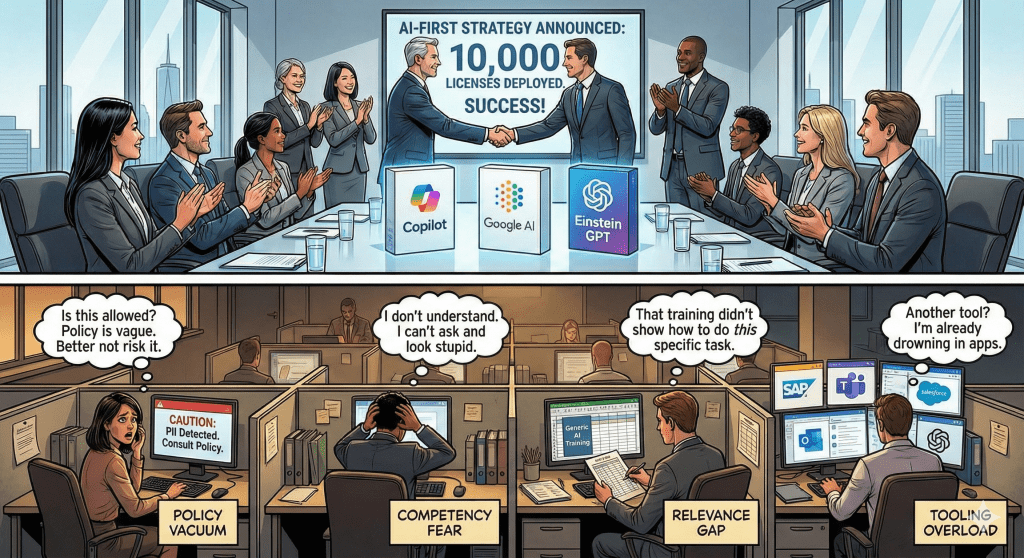
Almost every Fortune 500 company & most of the startups announced an “AI-first strategy” in 2024. Microsoft sold Copilot licenses by the millions. Google pushed Workspace AI. Salesforce launched Einstein GPT.
The CFO approved the budget. The CIO deployed the tools. The CEO announced it at the all-hands.
Yet when you walk through most operations floors in 2026, what do you actually see?
- The Engineering team is building agents and experimenting with LangChain.
- The Data Science team is fine-tuning models.
- The IT department is attending AI governance meetings.
And everyone else? They’re still copying data from PDFs to Excel by hand.
The hard truth: Most enterprises are achieving less than 20% utilization of their AI investments.
The tools are deployed. The licenses are purchased. The training sessions are complete.
But the majority of the workforce isn’t using them or worse, is actively avoiding them.
The Enterprise AI Paradox
Here’s the conversation happening in boardrooms right now:
CFO: “We spent $5M on AI tools. Where’s the productivity gain?”
CIO: “We deployed Copilot to 10,000 seats. Usage data shows 1,200 active users.”
Business Unit Leader: “My team keeps asking IT to build custom solutions. We have a 9-month backlog.”
HR: “Employee surveys show people feel ‘overwhelmed by new tools.’”
The problem isn’t the technology. Microsoft Copilot works. Google’s AI tools work. Salesforce Einstein works.
The problem is adoption architecture.
Most enterprises deployed AI tools the same way they deployed SAP in 2005: Top-down, IT-led, with a 40-slide training deck and a mandatory e-learning module.
Then they measured success by “licenses activated” and “training completed.”
And they wonder why nothing changed.
The Four Silent Adoption Killers
After analyzing deployment patterns across enterprise organizations, four barriers emerge consistently. These aren’t technical issues—they’re human ones.
Barrier #1: The Policy Vacuum (The Silent Killer)
This is the #1 reason enterprise AI adoption fails, and most leadership teams don’t even know it’s happening.
Here’s the conversation in thousands of cubicles right now:
Employee thinks: “I could use Copilot to analyze this customer data… but wait, is that allowed? This spreadsheet has email addresses. Is that PII? What if I accidentally paste something confidential and get called to HR?”
Employee decides: “Better not risk it. I’ll just do it manually.”
Enterprises rush to deploy AI tools, then either:
- Option A: Issue a vague policy like: “Use AI responsibly and don’t share confidential information.” (Translation: “We have no idea what’s allowed, so we’re making YOU liable if something goes wrong.”)
- Option B: Issue no policy at all. (Translation: “This is a trap. If I use it wrong, I’m getting fired.”)
- Option C: Issue a 47-page governance document. (Translation: “I’m definitely not reading this. Safer to just not use it.”)
The result? Employees with the most valuable use cases—the ones working with customer data, financial records, operational information—self-select out of AI adoption entirely.
The organizational cost: The people who could benefit most from AI are too afraid to touch it.
A Finance Analyst who could save 10 hours a week won’t risk her career to find out if using Copilot for invoice reconciliation violates policy.
A Customer Success Manager who handles 50 tickets a day won’t use AI to draft responses because every ticket contains customer PII.
A Sales Rep won’t use AI for proposal generation because he’s not sure if prospect data counts as “confidential.”
They all choose safety over productivity. And you can’t blame them.
Barrier #2: The Competency Fear
In most corporate cultures, admitting “I don’t understand this technology” feels like professional suicide especially for mid-level and senior employees.
A leader with 15 years of experience doesn’t want to raise their hand in an all-hands meeting full of his reportees or juniors and ask: “What exactly is a prompt?”
So they nod along. They attend the training. They get the license activated.
And then they never open it.
This creates a “pretend adoption” culture. People claim they’re using AI. Leadership believes the numbers. But actual usage is near zero.
The organizational cost: Your most experienced employees the ones with the deepest domain knowledge are opting out because asking for help feels like admitting incompetence.
Barrier #3: The Relevance Gap
Most enterprise AI training focuses on features, not workflows.
The typical Copilot training session looks like this:
- “Here’s how to open Copilot in Word”
- “Here’s the summarize function”
- “Here’s how to access it in Teams”
- “Here’s the chat interface”
What’s missing: “Here’s how this solves the actual problem you complained about last Tuesday.”
A Finance Analyst doesn’t care that Copilot can “summarize documents.” They care that they spend 3 hours every week manually categorizing vendor invoices.
A Customer Success Manager doesn’t need to know all of Copilot’s capabilities. They need to know: “Can this help me stop writing the same password-reset email 47 times a week?”
When training is feature-focused instead of pain-focused, people attend, nod politely, and return to their desks thinking: “That was interesting, but I don’t see how it helps MY actual job.”
The organizational cost: Training completion rates are high. Actual application rates are zero.
Barrier #4: The Tooling Overload Excuse
This objection is real and legitimate: “We already use SAP, Salesforce, PowerBI, Concur, Workday, Slack, Teams, and six internal tools. Now you want us to learn another interface?”
For many employees, AI feels like “one more thing” added to an already overwhelming stack.
The mistake enterprises make: positioning AI as “another tool to learn” instead of “the tool that reduces your other tools.”
If the deployment message is “Here’s another login, another interface, another training module, another thing to remember,” resistance is rational.
The organizational cost: Even employees who might benefit from AI opt out because they’re already at cognitive overload.
Why This Matters Now (And Why Waiting is Expensive)
Some executives treat low AI adoption as “not urgent.” The thinking: “We deployed it. Eventually people will use it.”
This is a mistake.
Here’s what’s happening while you wait:
- Your competitors are unlocking it: The enterprises that solve adoption first are creating a 2-3 year productivity advantage.They’re closing month-end in 4 days instead of 8. Their sales reps are spending 60% of time selling instead of 40%. Their customer success teams are handling 2x the ticket volume with the same headcount.
- Your employees are burning out: The teams doing manual work that AI could handle aren’t just inefficient they’re exhausted.They watch Engineering talk about AI agents while they’re still copy-pasting data at 8pm on Friday. This creates resentment and attrition.
- Your AI investment is depreciating: That $5M you spent? It’s delivering $1M of value and every quarter you delay adoption, you’re losing ROI that you’ll never get back.
- Your talent strategy is at risk: Top performers don’t want to work at companies where they’re manually doing work that AI could handle. “We have Copilot but nobody uses it” is not a selling point for your next hire.
The Path Forward
The good news: This is solvable.
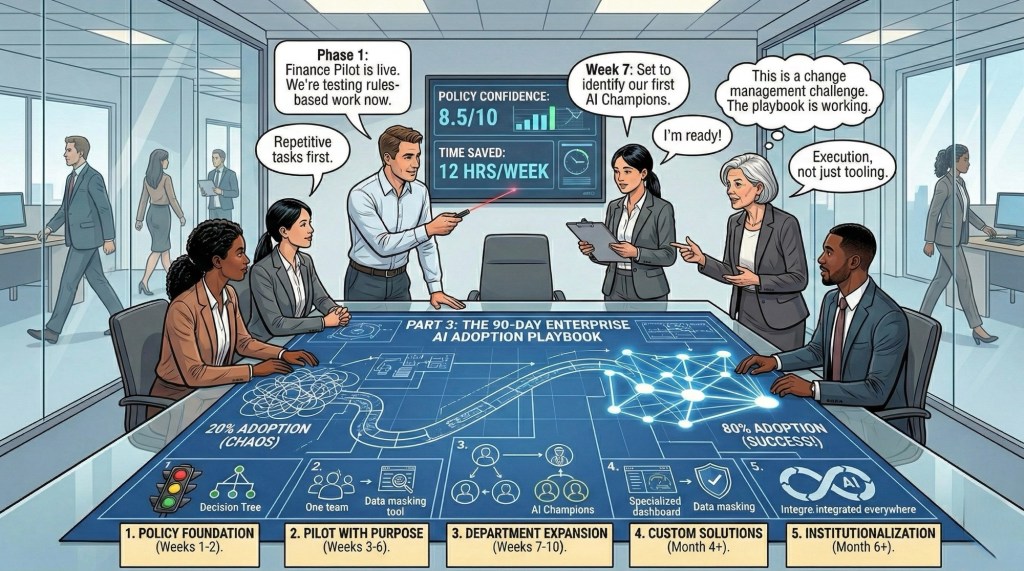
The organizations achieving 60-80% AI adoption rates aren’t doing anything magical. They’re following a structured approach that treats adoption as a change management challenge, not a technology deployment.
They understand that the barrier isn’t technical capability. It’s confidence.
Employees don’t need to become prompt engineers. They need to feel safe trying.
They don’t need to understand transformer architecture. They need to know: “Can I use AI for THIS specific task I’m doing right now without getting in trouble?”
They don’t need a 40-slide training deck. They need 3 copy-paste templates that solve their biggest time-wasters.
The formula is simpler than most enterprises realize:
Clear Policy + Practical Training + Real Support = Confident Adoption
Policy first. Always.
Because without policy clarity, everything else fails.
An employee will avoid a tool that could save them 10 hours a week if they believe using it might get them fired.
What’s Next
Over the next two weeks, I’m going to break down exactly how to solve this.
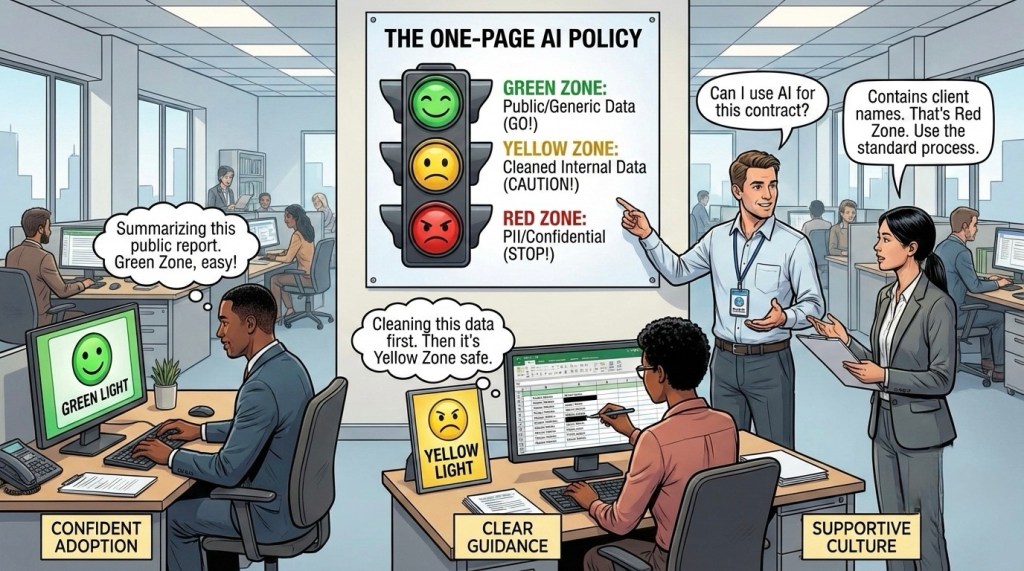
- Next week (Part 2): I’ll share the one-page AI policy framework that can help unlock adoption – the GREEN/YELLOW/RED decision tree that gives employees instant clarity on what’s safe vs. risky.
- Week 3 (Part 3): I’ll walk through the exact 90-day rollout plan for taking your organization from 20% to 80% adoption, with real implementation examples from Finance, Sales, and Customer Success teams.
The companies that win in 2026 won’t be the ones with the most sophisticated AI models.
They’ll be the ones who figured out how to make 8,000 employees feel confident using the tools they already have.
Subscribe to The Abhay Perspective to get Part 2 delivered to your inbox next Monday.
This is Part 1 of a 3-part series on Enterprise AI Adoption. Subscribe to The Abhay Perspective here & on LinkedIn to get Part 2 next week: “The One-Page AI Policy That Unlocks Enterprise Adoption.”

 The Abhay Perspective
Leave a reply to From “Clueless” to Confident: The GREEN/YELLOW/RED AI Policy – The Abhay Perspective Cancel reply