As we move into 2026 which I predict will be the “Year of the Enterprise AI” we are seeing a gold rush. From scrappy startups to massive GCCs, every leader worth their salt is pivoting toward Agentic AI.
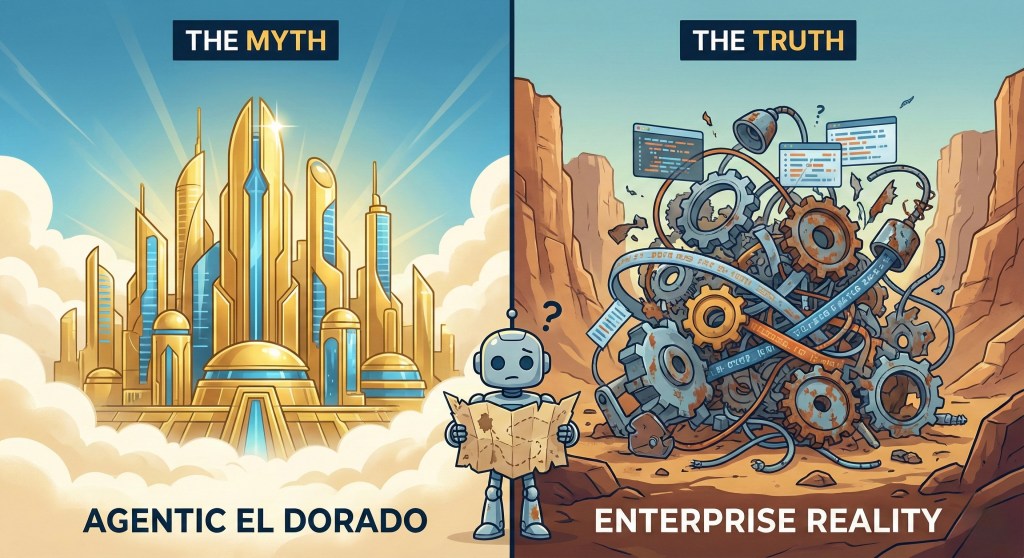
And why wouldn’t they? We’ve all been sold the same magic wand: autonomous agents that reason, plan, and execute complex tasks at a fraction of the cost. It sounds like the legendary city of gold: El Dorado (the mythical city of immense wealth that explorers could never find).
But here is the uncomfortable truth: Most of us are never going to get there.
Let’s look at the data. A 2025 MIT study concluded that 95% of GenAI pilots failed to produce ROI. Research notes that while 65% of enterprises launched pilots, only 11% of companies moved to full deployment. The gap between “Proof of Concept” and “Production” isn’t closing; it’s widening.
Why? Because we are training our digital workforce on the Map, not the Terrain.
The “Data” Trap: Why SOPs or Logs Are Not Enough
The current industry playbook is dangerously simple:
“Just use RAG (Retrieval-Augmented Generation). Feed the agent your SOPs and your historical data, and let it figure it out.”
This is a recipe for disaster.
As someone who spent 15+ years in Frontline Operations and the last 5 years mining them, I can tell you a secret: SOPs are not reality. SOPs cover maybe 60% of the work. The other 40%? That’s the “Wild West.” It’s full of exceptions, regional workarounds, and tribal knowledge that human workers navigate using intuition.
When an AI trained only on SOPs hits that 40% reality, it doesn’t improvise—it panics. It hallucinates.
The counterargument?
“Just feed the agent ALL historical data—let it learn from every variation and find optimal solutions. After all, these are intelligent agents, right?”
Wrong.
If you feed an Agent raw event logs or uncurated historical data, you are not teaching it how to work. You are teaching it how to struggle.
Your raw logs are full of:
- Inefficiency: The user who clicks “Refresh” 10 times because the system is slow.
- Compliance Risks: The manager who bypasses approval limits to get a deal done.
- Chaos: The 40% of cases that required messy, manual workarounds.

If you train an Agent on raw logs, it learns that bypassing security is “standard procedure” because it sees humans doing it 40% of the time. You are effectively automating your own dysfunction.
The Solution: Process Mining as the “Curation Layer”
This is where Process Mining stops being an “Audit Tool” and becomes the Intelligence Engine for AI.
We don’t just want the agent to know what happened; we want it to know what should happen.
Process Mining takes those millions of raw data points and structures them into a Process Graph. It allows us to perform Variant Analysis to segregate the paths:

- The Happy Path: The standard, compliant process. (Train the Agent on this).
- The “Positive” Deviations: The shortcuts taken by your best employees that actually resulted in faster resolution without risk. (Train the Agent to adopt these optimisations).
- The “Negative” Deviations: The compliance breaches and rework loops. (Hard-code the Agent to never take these paths).
We aren’t just giving the Agent a map; we are giving it a GPS with traffic data, highlighting exactly which routes are fast and which ones lead to a cliff.
The Enterprise Architecture: The D.I.G. Framework
To scale Agentic AI from a cute demo to an Enterprise asset, Ops Leaders need to implement the DIG Framework: Discovery, Integration, Governance.

DISCOVERY: Contextual Variant Analysis
The Old Way: “Here is the PDF handbook.”
The DIG Way: “Here is the Process Graph.”
Before writing a single line of code, we use Process Mining to ingest logs from ERPs, CRMs, and Ticketing systems to build a Digital Twin of the operation.
We identify the Standard Operating Procedures (SOPs) versus the Actual Operating Procedures (AOPs).
We label the historical data: Instead of feeding the AI 10,000 generic cases, we feed it 2,000 “Gold Standard” cases.
Result: The Agent starts with the wisdom of your best employee, not the confusion of your average one.
INTEGRATION: Synthetic Scenario Training
The Old Way: “Test it in production and see what breaks.”
The DIG Way: “Simulation before Deployment.”
Process mining allows you to simulate the agent’s behavior against your actual historical data—and see how the Agent reacts in a sandbox.
- Does the Agent stick to the “Happy Path”?
- How does the agent handle the 40% of cases that require manual intervention?
- Does it create a new bottleneck downstream?
- Does it find a new way to solve problems more effectively?
- Does it degrade gracefully when encountering edge cases?
Result: You aren’t debugging in production with live customers, ensuring it survives contact with reality.
GOVERNANCE: Real-Time Conformance Checking
The Old Way: “Human-in-the-loop (HITL) monitoring everything.”
The DIG Way: “Automated Guardrails.”
In a deployed environment with thousands of transactions per hour, you cannot have humans watching every move. You need Continuous Conformance Checking.
The Process Mining engine sits parallel to the AI Agent. It monitors every step the Agent takes against the defined Process Model in real-time.
- The Check: If the Agent attempts a step that matches a “Negative Deviation” (e.g., skipping a fraud check), the Mining Engine blocks the action and flags a human immediately.
- The Loop-Back: If the Agent finds a new way to solve a problem that works, the Mining Engine flags this as a potential “New Best Practice” for review.
- Human escalation protocols with context: When the agent encounters scenarios beyond its training, it doesn’t just fail—it escalates to humans with full process context, enabling faster resolution and continuous learning.
Result: Trust. You can let the Agent run autonomously because the Guardrails are mathematical, not just aspirational.
The Abhay Perspective:
We are entering the era of the “Autonomous Enterprise,” but many organizations are trying to navigate it with static maps.
An AI Agent without Process Mining is like a Ferrari without a speedometer. It is fast, it is expensive, and you are going to crash it the moment you hit a curve.
The AI provides the Reasoning, but Process Mining provides the Reality.
So, before you deploy your next agent, ask yourself: Do you actually understand the process you are about to automate?
If you hesitated, stop building. Map the terrain first.
Then, and only then, can you find the city of gold.
What’s your take? Are you mapping your processes before deploying agents, or are you still navigating with static SOPs or trusting AI’s intelligence? Drop your thoughts below—I’d love to hear how other enterprises are approaching this.
Found this useful? I’ll be breaking down more practical strategies for operationalizing AI in future editions of The Abhay Perspective. Subscribe below & also to my Newsletter on LinkedIn to get more such updates
#AgenticAI #ProcessMining #EnterpriseAI #AIGovernance #DigitalTransformation
 The Abhay Perspective
Leave a comment