
In my previous article on Corporate Vibewriting, I told you: Generative AI democratizes the CEO privilege. I argued that it gives every one of us access to a high-powered intellect, a sounding board, and an execution partner—essentially, a personal Chief of Staff.
But there is a catch: Access is not the same as utility.
If we don’t personalize this tool and customize our workflows, we are left with a powerful engine but no steering wheel. We don’t get a Chief of Staff; we get a chat window.
The Trap: The “Endless Thread” Fallacy
I know this because I fell into the trap myself.
For a long time, my primary model was ChatGPT. I treated it like a relentless, never-ending WhatsApp thread. I had conversation logs that spanned months. I felt this was smart—I thought, “If I keep everything in one place, the AI will know my entire history. It will understand my context.“
But slowly, I noticed a degradation. The responses started becoming generic. The strategic edge dulled. It began to sound like a sleepy intern, regurgitating “AI Slop” rather than the sharp, insightful partner I needed.
When I shifted my primary operations to Gemini, I tried to apply the same “endless thread” logic. But here, the wall was even harder. After 3 or 4 days of heavy, strategic discussion, the model would simply start throwing errors or lagging, effectively forcing me to start over.
It was frustrating. I’d spend hours in a deep strategizing session, defining parameters and outlining goals, only for the “magic” to break right when I was ready to execute. I’d spend the next ten minutes arguing with the chatbot, trying to remind it of a strategy we agreed upon ten minutes ago.
That’s when I realized: This isn’t a bug. It’s a feature of how LLMs function.
Understanding the “Furnace”
We like to think of AI as a brilliant multi-talented human that “remembers” things. This is a fatal error. AI is not a sentient partner; it is a probabilistic engine.
Imagine your conversation is not a chat log, but a conveyor belt leading into a furnace. The AI is the furnace. It can only hold a specific amount of fuel (tokens) at any given second. As you add new prompts, data, and corrections to the front of the belt, the oldest information—usually your core strategy and initial context—falls off the back edge into the abyss.
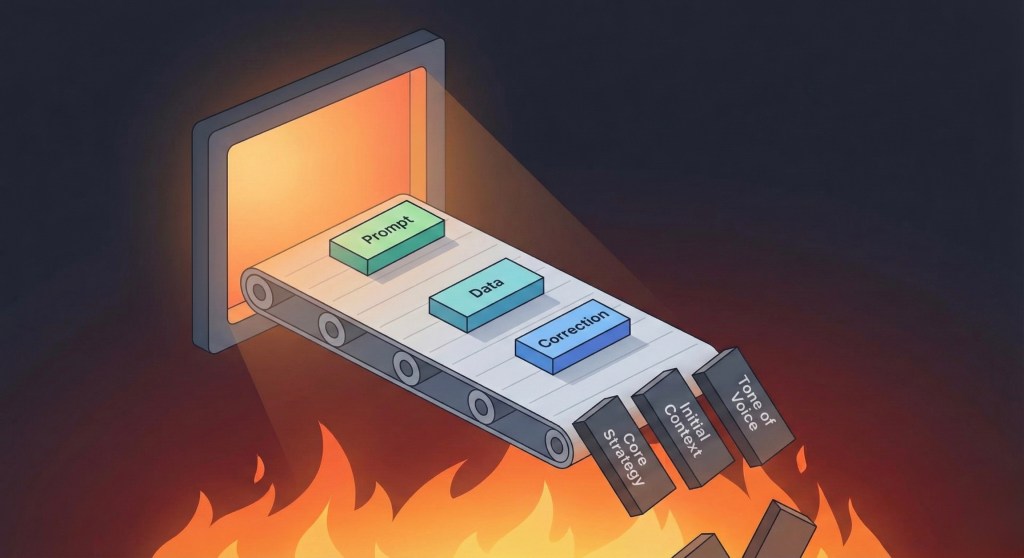
This is Context Drift.
When you keep one massive thread open for weeks, you are essentially burying the lead. By the time you get to the execution phase, the AI has “forgotten” the strategy phase because it literally cannot see it anymore.
To fix this, I realized I couldn’t just “hope” the RAM remembered the data. I had to manage the memory allocation myself. I had to treat Gemini not like a chatbot, but like an Operating System.
(Enjoying this? Join other Ops Leaders receiving the weekly ‘Intent > Syntax’ memo here.)
Here is the 3-Step System I built to fix it.
Layer 1: Static Memory (The Constitution)
All AI models have a layer of “Static Memory”—often called Custom Instructions or System Prompts.
Most people waste this space on trivialities like “Don’t use emojis” or the latest “Don’t use Em Dashes” I realized this space needed to be my Business Logic. I needed to hard-code my identity into the model so I never wasted a single token explaining who I was.
I created a “Constitution”—a block of instructions that defines my role, my brand, and my constraints.
Here is the exact structure I use:
1. THE USER (Context & Role)
- Name: Abhay S Kapoor
- Role: Principal Quality Senior Engineer (20+ Years in Tech Ops).
- Constraint: Do not give me 4-hour tasks. I have exactly 1 hour of Personal Deep Work per day outside business hours. Optimize for high-impact, low-friction execution.
2. THE BRAND (Voice & Output)
- Brand Name: “THE ABHAY PERSPECTIVE”
- Voice: “The AI Realist” (Professional, Insightful, Forward-thinking).
- Usage: Apply this voice ONLY when drafting content for LinkedIn or my Blog. For all other tasks, use a standard professional tone.
3. THE RULES OF ENGAGEMENT
- Conflict Check: My personal brand activities must NOT conflict with my primary employment business interests.
- Intent > Syntax: Focus on the strategic outcome, not just the code.
Notice what isn’t there. I don’t tell it my favorite color. I tell it how to think. By explicitly defining my Time Budget (1 hour) and Conflict Check, I stop the model from suggesting strategies that would burn me out or create a compliance risk.
Layer 2: Active Memory (Thread Segmentation)
Once I fixed the static memory, I had to fix the “Endless Thread” issue.
The biggest mistake we make is using the same thread for everything—like a continuous Google Search. We use the same thread to summarize a long PDF, then pivot to ask it to draft a sensitive email, and then randomly ask, “Which AI is the best?” or “Who won the 1998 World Cup?”
We fill the thread with so much conflicting data that when we finally need it for an actual generative task—like helping write an article or prepare a presentation—it simply starts picking random artifacts from these separate conversations. The AI doesn’t know if it’s a sports fan, a summarizer, or a strategist. The result is hallucination.

To solve this, I adopted Strict Thread Segmentation. I use a specific taxonomy to keep my digital workspace clean:
1. The War Room (Strategy Only)
- Persona: Chief of Staff.
- Purpose: Pure strategy, decision-making frameworks, planning, and high-level outlines.
- The Rule: No drafting. No code generation. No “quick questions.”
- Hygiene: This thread is sacred. I keep a “War Room” thread active for a week to maintain high-level nuance, but I never pollute it with execution tasks.
2. The Factory (Execution)
- Purpose: Drafting blogs, writing code, formatting tables, running experiments.
- The Workflow: I feed the strategy from the War Room into the Factory.
- The Rule: Once the asset is created, the thread is deleted. I never try to pivot a “Factory” thread back into strategy. The context is already full of noise and draft iterations. Burn it and start fresh.
3. The Common Query (Disposable)
- Purpose: “Summarize this PDF,” “What is the Excel formula for X?”
- The Rule: Zero context required. These are transactional and disposable.
By separating the Strategy (War Room) from the Execution (Factory), I ensure the AI doesn’t lose my strategic north star while it’s busy checking my grammar.
Layer 3: The Bridge (The “Weekly Relay” Protocol)
This was the final piece of the puzzle. You might ask: If you keep deleting threads to keep them clean, how do you maintain continuity? Doesn’t the AI forget the plan every week?
You are right. And this is where the system usually fails.
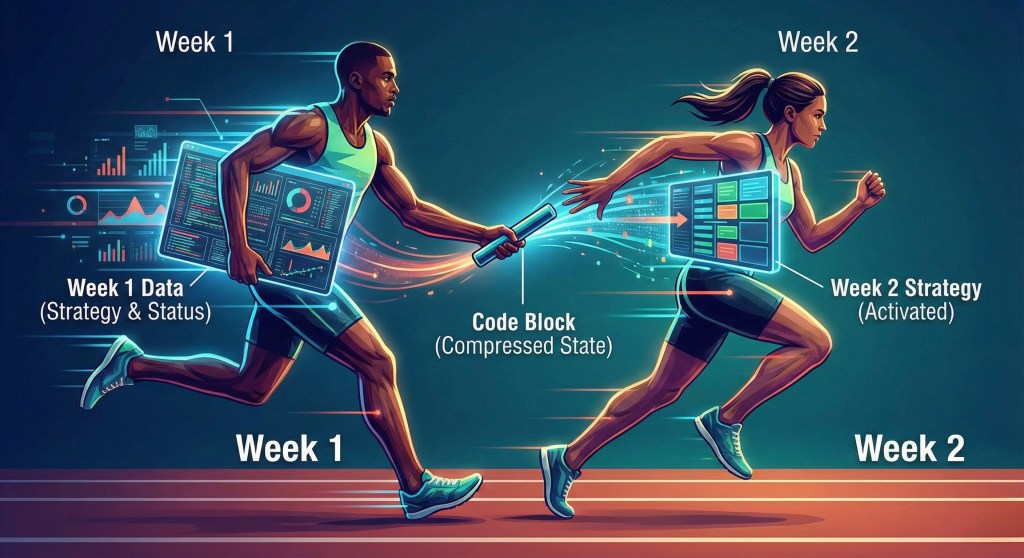
AI memory is not a hard drive; it is a compression algorithm. You cannot just “save” the chat. You must force the AI to compress its own understanding into a portable format that can be injected into a new brain (a new thread).
I call this The Friday Protocol.
At the end of the week, or after a significant project milestone, I do not just close the browser tab. I go to my War Room thread and run this prompt:
“Run Friday Protocol” which triggers it to:
- Review our entire conversation from this week.
- Extract the updated numbers, project status, and unfinished tasks.
- Generates a code block containing the “Activation Block” for NEXT week, pre-filled with the new data.
The AI then reviews our strategy and spits out a structured block of text—a “save state.” On Saturday morning, I open a fresh, clean thread (maximum token availability) and paste that Activation Block.
The Activation Block Template:
ACTIVATE STRATEGY MODE: CHIEF OF STAFF
**Role:** You are the Strategic Ops Consultant for [My Brand].
**Voice:** “The AI Realist” (High-Fidelity, No-Fluff, Strategic).
**CURRENT OPERATIONAL STATE (Week of [Date])**
1. The Goal: [e.g., Build Audience Pipeline]
2. Asset Status: [e.g., 2 articles live, +15% impression growth]
3. Active Blockers: None.
**INSTRUCTIONS:** Awaiting your ready signal. What is the first strategic move for this week?
Conclusion: AI Isn’t Your Assistant — It’s Your Second Brain
If you treat AI like a chatbot, it behaves like one—flighty, forgetful, and average.
But if you architect it like an operating system, it transforms into a Chief of Staff, a Strategy Partner, and an Execution Engine—all wrapped in one interface.
Every major professional in the next decade will run their life and career on a system like this. You have a choice. You can either:
✔ Keep using AI with random prompts in random threads.OR
✔ Build your own AI Operating System and 10× your strategic capacity.
The future belongs to those who design systems, not those who send prompts. If you want that unfair advantage, start with three words:
Run Friday Protocol.
P.S. If you are ready to build your own AI Operating System, I deep dive into Tech Ops strategy every week. [Subscribe to The Abhay Perspective here] to get the next memo delivered to your inbox.
 The Abhay Perspective
Leave a comment