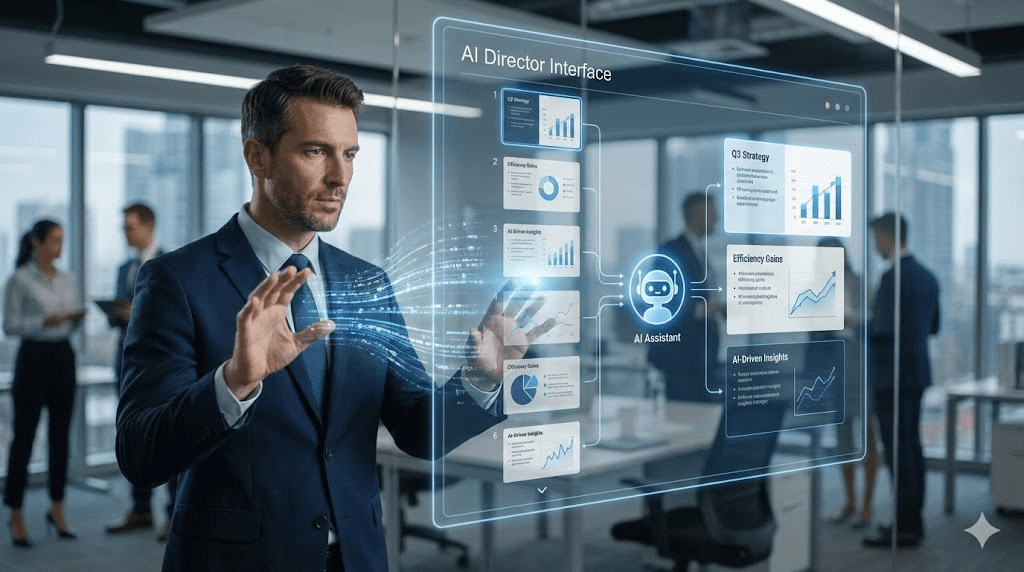
The Silicon Valley Shift
In the coding world, a quiet revolution is happening. Andrej Karpathy recently popularized the term “Vibecoding.”
The premise is simple: Software engineers are no longer obsessing over semicolons or syntax errors. They describe the functionality they want (the logic), and the AI writes the code (the execution). The human focuses on what the app does; the machine focuses on how it is built.
Yet, walk into any corporate office, and you will see the exact opposite.
Highly paid Leaders/Managers are spending hours aligning text boxes in PowerPoint. VPs are agonizing over the grammar of a Q3 report. We are still stuck in “Syntax Mode,” judging leaders by how well they pick font colors rather than their ability to think.
It is time to bring the “Vibe” revolution to the boardroom. It is time for Corporate Vibewriting.
(Enjoying this? Join other Ops Leaders receiving the weekly ‘Intent > Syntax’ memo here.)
The CEO Privilege (Democratized)
For decades, the most powerful CEOs and leaders never wrote their own memos.
They didn’t open Microsoft Word. They dictated a stream of consciousness to a Chief of Staff or an Executive Assistant:
“Tell the team that Q3 numbers are down, we need to tighten the belt on travel, but keep the tone optimistic because Q4 pipeline looks good.”
The CEO provided the Intent. The EA provided the Syntax.
Nobody called the CEO “lazy.” We called them “efficient.” We understood that their brain cycles were too valuable to be spent on sentence structure.
Vibewriting is simply the democratization of this privilege.
AI gives every Operations Manager, Team Lead, and Director their own Chief of Staff. It allows you to operate at the “CEO Level” of your own workflow.
Redefining “Corporate Vibewriting”
So, what does this look like in practice? It is not about asking ChatGPT to “write a report.” That yields generic fluff.
True Vibewriting is the skill of High-Fidelity Delegation, where we separate Intent from Execution:
- The Vibe (You): The raw experience, the specific strategic angle, the emotional weight, the “Soul.”
- The Engine (AI): The grammar, the sentence structure, the vocabulary, the flow.
Combining the Vibe and the Engine gives us a superior product with faster delivery. Let’s look at two examples.
1. The Report (Raw Data → Strategic Narrative)
- The Old Way: You stare at a blank page, trying to find the words to explain a 10% dip in efficiency.
- The Vibe Way: You dump your raw, messy thoughts into the model: “Here is the raw data. Efficiency dropped 10% because of the server migration. It’s a temporary blip. I need a summary for the VP that owns the problem but emphasizes that the long-term fix is already deployed. Keep it data-heavy, no excuses.”
- The Result: The AI handles the flow. You review the strategy.
2. The Presentation (Concept → Visualization)
- The Old Way: You spend 45 minutes finding the right “corporate blue” for a slide background.
- The Vibe Way: You use a tool like Gamma or an Enterprise LLM to say: “I need a 5-slide deck outlining the new shift roster. Slide 1 is the problem (burnout). Slide 2 is the data. Slide 3 is the proposed rotation. The vibe should be urgent but solution-oriented.”
A Critical Note on Security: Vibewriting is not an excuse to leak IP. While many companies restrict public AI tools, most are moving rapidly toward Enterprise environments (like MS Copilot) where data is safe.
Even without those, you can direct the structure without sharing the secrets. You can ask AI to “Design a slide layout for a quarterly deficit,” without uploading the actual P&L. Use the engine for the visual, not the variable.
The Defense: “Is This Lazy?”
There is a lingering guilt in the corporate world. We feel that if we didn’t type the words, we didn’t “do the work.” Many early adopters will tell you how colleagues scoffed at them for writing emails or building slides using AI, even when the output was superior or how many who use AI then edit fonts etc. to hide the fact that they used AI.
Critics will point to “AI Slop.” They will argue that AI generates generic fluff, abuses the Em Dash, Oxford comma, or sounds robotic. They will say it lacks substance.
But this is not a failure of the Engine; it is a failure of the Director.
If you provide generic input, you get generic output. The “fluff” appears when the user lacks a clear opinion.
For the critics, the answer is simple: It is a skill issue. As we progress, the “Vibewriter” learns to tune the model, correct the tone, and inject specific constraints. Practice makes perfect.
Let me be clear: Syntax is not the work. Insight is the work.
If you spend 4 hours formatting a report, you are doing low-leverage labor. If you spend 30 minutes Vibewriting the draft and 3.5 hours analyzing the data to find a new efficiency breakthrough, you are doing Operations.
The Future: From Writers to Directors
We are entering an era where “Fluency” is no longer a competitive advantage. Perfect grammar is now a commodity.
This levels the playing field. It puts a manager in Delhi—whose first language isn’t English—on par with a colleague in London or New York.
The Leaders who win in the next decade won’t be the ones with the best vocabulary. They will be the Directors of Intelligence.
- They will know how to direct the “Vibe.”
- They will know how to spot a strategic error in an AI draft.
- They will treat AI not as a cheat code, but as a subordinate engine that requires strong leadership.
Stop apologizing for using power tools. Stop hiding your workflow. The hard work is the Strategy. The typing is just logistics.
Don’t confuse the two.

 The Abhay Perspective
Leave a comment