Back in November I wrote an article about how AI now gives every OPS leader the CEO privilege of having their own Chief of Staff – Dump your intent into a model. Let it handle the grammar. Focus your brain on the strategy.
I called it Corporate Vibe-Writing.
But since then in just 6 months the world of AI has changed & opened up new levels.
What’s Changed
When I wrote that piece, AI was still mostly a drafting tool. You prompted it. It produced text. You reviewed. You shipped. Useful. But still fundamentally reactive. You still had to initiate every single task.
In 2026, that model is obsolete.
We now have AI Agents, digital workers that don’t just respond to prompts. They receive a goal, build a plan, use tools, take action, and report back. They can browse the web, write and execute code, send emails, update spreadsheets, and trigger downstream workflows without you holding their hand through each step.
The shift is not incremental. It is architectural. We have moved from AI as a writing assistant to AI as a workforce. And most operations leaders are still using it like a fancy autocomplete.
The New Skill: Vibe-Managing
Vibecoding gave developers a new way to build software. Vibewriting gave knowledge workers a new way to produce content. Vibe-Managing is the next layer and it is the one that actually moves the needle on operations.
The premise is the same: you provide the Intent. The Agent handles the Execution. But the scope is now your entire work layer, not just your documents.
The separation looks like this:
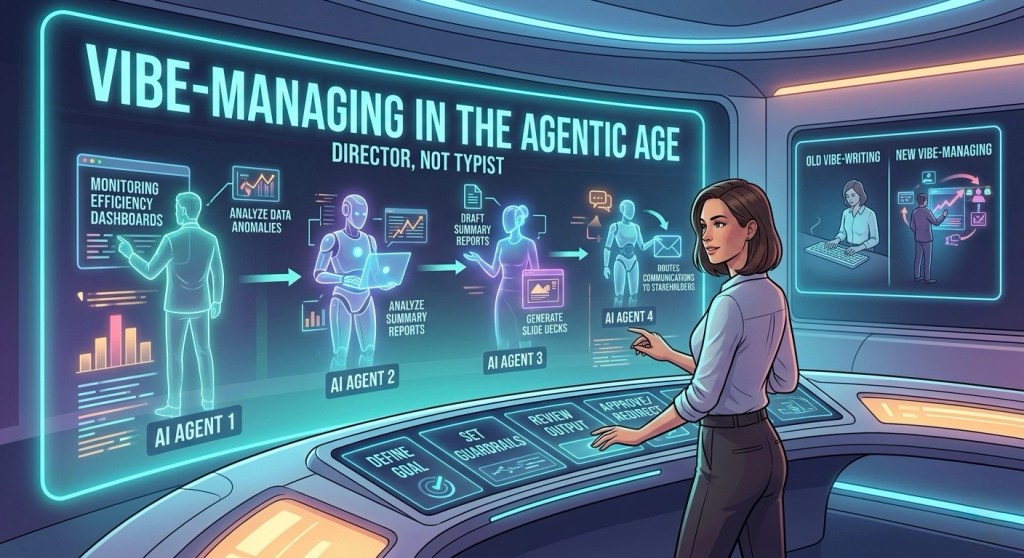
- Your job (The Director): Define the goal. Set the constraints. Establish the guardrails. Review the output. Make the judgment call.
- The Agent’s job (The Engine): Research, draft, execute, iterate, report.
You are no longer a knowledge worker. You are a manager of digital workers.
What This Looks Like in Practice
Old Vibewriting approach: You dump your thoughts into ChatGPT. It drafts the VP summary. You edit and send. One task. One output. You still managed every step.
Vibe-Managing approach: Your agent monitors the efficiency dashboard. When it detects a deviation beyond threshold, it pulls the relevant data, cross-references the last three incident logs, drafts the VP summary with your preferred framing, and flags it for your review. You approve or redirect. The agent executes. You went from typist → editor → approver.
The Presentation:
Old way: You Vibewrite the brief. AI generates the slides. You spend 45 minutes tweaking.
New way: Agent receives the brief, pulls live data from your reporting stack, generates the deck in your template, and sends you a preview with three alternative narrative angles to choose from. Your job is to pick the angle. Everything else was handled.
The Real Unlock: Multi-Agent Workflows
Single agents are useful. But the real operational leverage comes from orchestrated agent teams. Think about a standard ops reporting cycle:
- Agent 1 monitors data sources and flags anomalies
- Agent 2 drafts the narrative around the flagged data
- Agent 3 formats it into the standard report template
- Agent 4 routes it to the right stakeholder based on content type
- You receive a final package for review and sign-off
That entire chain runs without you touching it until the approval step. A process that traditionally consumes 14 hours of analyst time per week now takes 12 minutes of Director review time.
This is not science fiction. The infrastructure for this exists today like n8n, Make, Microsoft Copilot Studio, Claude Co-work and a growing stack of enterprise-grade agentic platforms are being deployed right now. They aren’t just “IT integration tools” they are Business Logic Engines being deployed by operations teams right now.
The bottleneck is not the technology. It is the absence of leaders who know how to design the workflow, define the guardrails, and manage the output quality. That is the skill gap. That is your opportunity.
The Three Things a Vibe-Manager Must Get Right
1. Goal Definition: Agents fail when the goal is vague. “Improve reporting” is not a goal. “Generate a weekly efficiency summary by 8am Monday, flagging any metric more than 10% below the 30-day average, in this format, routed to these stakeholders” — that is a goal. Precision of intent is the primary skill. Everything else follows from it.
2. Guardrails, Not Micromanagement: You do not supervise every step. You set the boundaries within which the agent operates. What data can it access? What actions can it take autonomously? What requires human approval? Where does it stop and escalate? Guardrails replace supervision. Design them well upfront or you will spend more time firefighting than if you had done the task yourself.
3. Output Review: The agent is not the decision-maker. You are. Review is not optional — it is the job. The Director’s value is in catching the strategic error the agent missed, not in doing the execution the agent already handled.
The Mindset Shift That Matters
When I wrote about Vibewriting in November I made one argument: Syntax is not the work. Insight is the work.
That is still true. But the scope has expanded. It is no longer just about who writes the words. It is about who executes the tasks.
If you are still running every report manually, initiating every data pull, chasing every update across five systems you are not doing operations. You are doing logistics.
The leaders who will define the next decade of enterprise operations are not the ones who work the hardest. They are the ones who build the most capable digital workforces and manage them with precision.
Stop being the worker. Start being the Director.
The agents are ready. The question is whether you are.
Found this useful? I’ll be breaking down more practical strategies for operationalizing AI in future editions of The Abhay Perspective. Subscribe below & also to my Newsletter on LinkedIn to get more such updates
If you want to bring this conversation into your community, reach out to me on: theabhayperspective.com/work-with-me
 The Abhay Perspective
Leave a comment